Rebuilding Europe: AI and the industrial productivity frontier
What's holding Europe's critical industries back — and how AI can change it
Download the report
Inside Europe's industrial productivity challenge — the execution capacity gap, why digitisation hasn't solved it, and where AI can make the difference.
Rebuilding Europe: AI and the industrial productivity frontier
Europe's industrial debate has changed
For much of the past three decades, the operating model was built around global efficiency: lean inventories, offshore production, low-cost supply, cheap energy and frictionless trade. That model has not disappeared, but it is no longer enough. Energy security, supply-chain resilience, defence readiness, decarbonisation and industrial sovereignty are now shaping how governments invest and how companies plan.
This shift has brought Europe's critical industries back to the centre of economic strategy. These are the asset-heavy sectors that power, move, build and maintain the real economy: industries like energy, utilities, manufacturing, logistics, infrastructure and construction. They do not just contribute to GDP. They determine whether households get reliable power, whether factories can operate, whether goods can move, whether infrastructure can be built, and whether strategic capacity can be scaled when Europe needs it.
That makes them central to Europe's next chapter. A more resilient Europe needs stronger domestic industrial capacity. A decarbonised Europe needs faster electrification, grid expansion and clean manufacturing. A more secure Europe needs greater defence-industrial readiness and less dependence on fragile supply chains. A more competitive Europe needs the industries that underpin the real economy to become more productive.
The policy agenda reflects the shift. The European Commission's Competitiveness Compass sets out three priorities for restoring Europe's economic dynamism: closing the innovation gap, decarbonising the economy and reducing strategic dependencies. The Clean Industrial Deal focuses on energy-intensive industries such as steel, metals and chemicals, and on the clean-tech sectors the Commission describes as central to future competitiveness.
But rebuilding Europe is not only a question of capacity. It is a question of capability. Europe can mobilise capital, set targets and announce new industrial programmes. It can build factories, grids, ports, plants and supply chains. But the value of that investment will be determined inside companies: in how quickly work moves, how effectively scarce expertise is used, how well data is connected, how fast decisions are made, and how reliably complex operations are executed.
Capacity is what Europe builds. Capability is what allows that capacity to perform. Productivity is the result.
AI enters this debate as a practical lever for increasing execution capacity: the operational ability to turn complexity, data and expertise into faster, safer and more reliable work.
The execution capacity gap
Europe does not lack ambition. It lacks room for error.
The investment requirement is already enormous. Mario Draghi's competitiveness report estimates that Europe needs at least €750–800 billion of additional annual investment to meet its digital, decarbonisation and defence objectives. The demographic backdrop is equally challenging: by 2040, the EU workforce is projected to shrink by close to 2 million workers each year.
At the same time, critical industries are being asked to do several hard things at once. They must maintain existing assets while modernising them. They must decarbonise while controlling costs. They must localise or diversify supply chains without losing competitiveness. They must comply with rising regulatory requirements while improving speed and service. They must adopt new technology while dealing with ageing infrastructure and scarce skills.
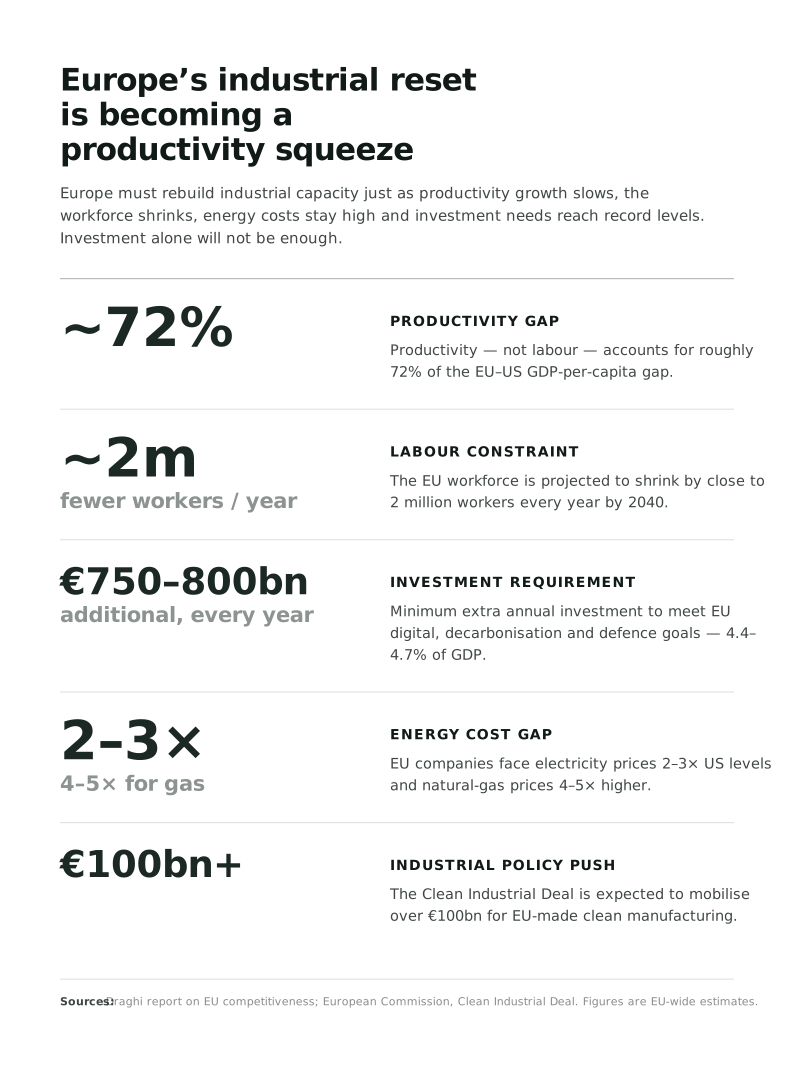
The energy system shows the scale of the challenge. The International Energy Agency estimates that more than 80 million kilometres of electricity grids will need to be added or refurbished globally by 2040, roughly equivalent to the entire existing global grid. At least 3,000 GW of renewable power projects are waiting in grid connection queues, making grids a major bottleneck in the energy transition.
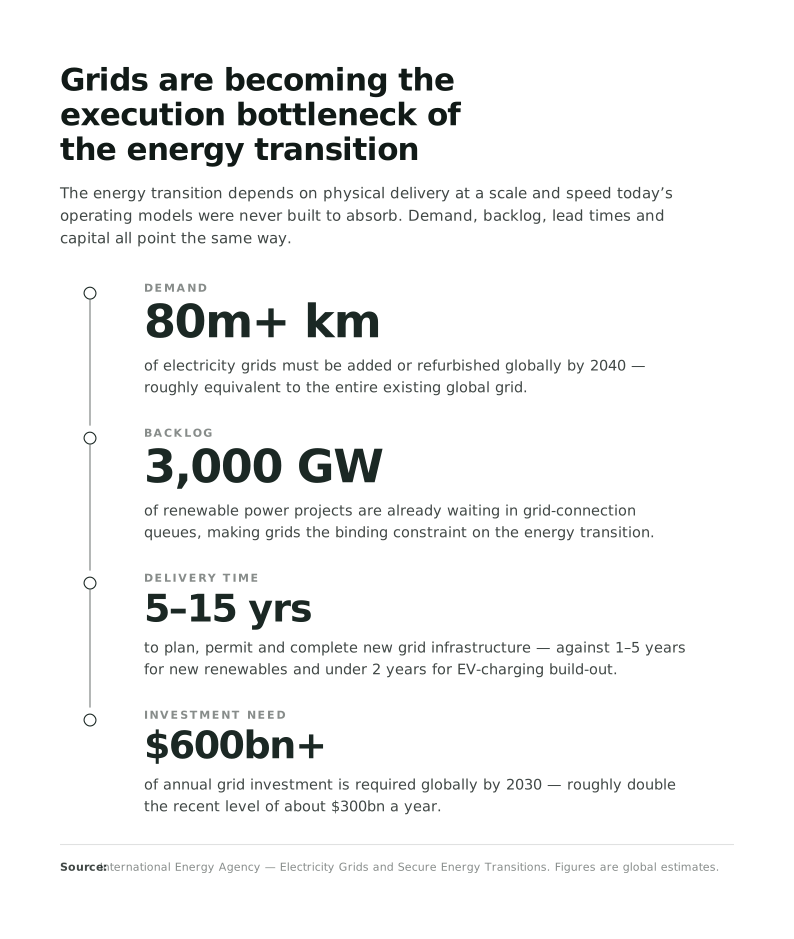
This is the execution capacity gap: the gap between Europe's industrial ambitions and the ability of organisations to deliver them at speed.
The gap is not only physical. It is operational. It sits in the parts of the business where work crosses functions, systems and suppliers: approvals, reconciliations, compliance evidence, planning changes, exceptions and decisions that depend on scarce expertise. Individually, these frictions can look manageable. At enterprise scale, they shape throughput, cost, resilience and customer outcomes.
Productivity leakage is visible inside the operating model
Recent UK research across large physical-industry employers gives a sense of the problem. Seventy percent of frontline workers said they often have to wait for approvals before they can do their job. Sixty-five percent said they had used IT workarounds because official systems were not fit for purpose. Two-thirds of both leaders and workers said at least 30% of working hours are spent on repetitive, low-value activities.
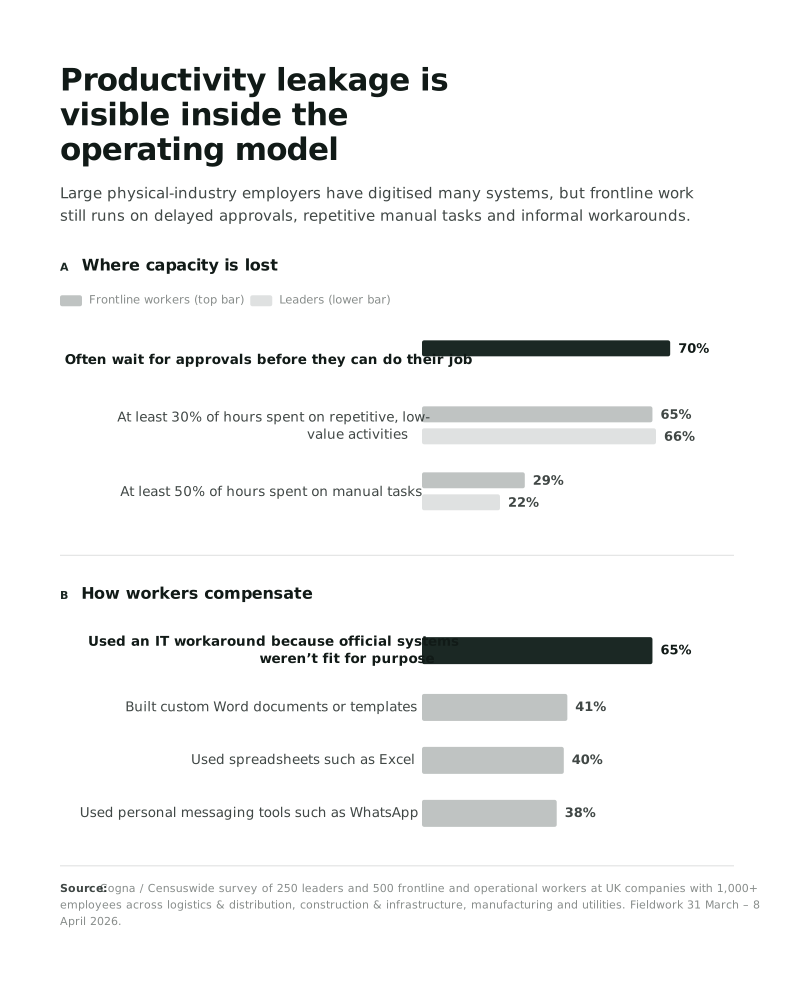
This reframes the productivity problem. The issue is not only whether companies have enough workers, assets or systems. It is whether the organisation is using the capacity it already has well enough.
Why digitisation has not solved it
Most large industrial companies are not starting from zero. They have invested in ERP, asset management, workforce management, CRM, reporting tools and data platforms. Many have spent years on digital transformation.
Yet the hardest work in critical industries often does not fit neatly into these systems. Enterprise software has been good at structured, repeatable processes. But much of industrial work is exception-heavy, time-sensitive and dependent on context. It crosses functions, systems, suppliers, regulators and assets. It requires judgement.
That is why digital transformation has often improved the system of record without fully improving the system of work.
The result is a familiar pattern. Official systems hold part of the truth. Documents hold another part. Local teams know what actually happens. Experienced workers carry the operational memory. Spreadsheets and messaging tools fill the gaps. Management gets dashboards, but not always the live context needed to improve execution.
This is not simply a technology failure. It is an operating-model failure. Productivity is lost where work crosses boundaries: between planning and delivery, field and office, asset and customer, contractor and operator, compliance and operations. AI can help when it starts from those boundaries, rather than from the technology itself.
AI’s role: turn operational context into productivity
AI is often discussed in abstract terms: models, copilots, chatbots, automation, intelligence. That framing is too broad for critical industries.
In industrial environments, AI creates value when it is attached to a specific job. It must understand the asset, the site, the customer, the regulation, the work order, the historical pattern, the approval chain and the operational constraint. It needs context.
This is where the next productivity frontier sits. Critical industries are data-rich and knowledge-deep, but much of that advantage is fragmented. AI’s role is to make that context usable at the moment work happens. That does not mean removing people from critical decisions. In safety-critical, regulated and asset-heavy environments, the goal is usually to improve decision quality, speed and consistency while keeping human oversight.
The point is not to replace skilled workers. It is to make scarce expertise go further.
This is already visible in energy. The IEA notes that AI is being used by energy companies to reduce costs, extend asset lifetimes, reduce downtime and lower emissions. It estimates that AI-based fault detection can reduce outage durations by 30–50%, while remote sensors and AI-based management could unlock up to 175 GW of transmission capacity without building new lines.
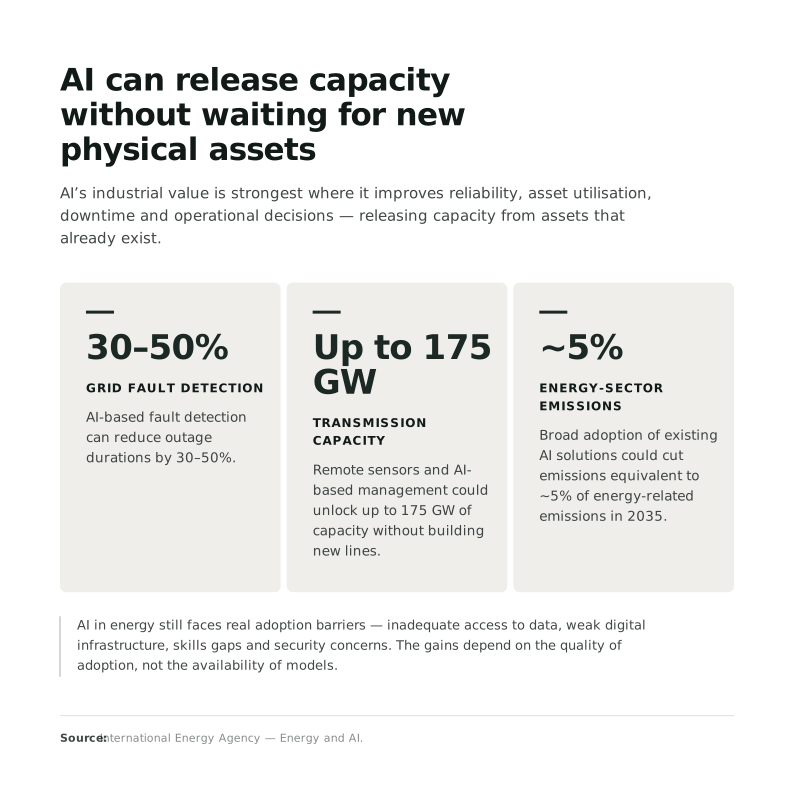
The constraint is adoption quality. The IEA also warns that the energy sector is not yet making the most of AI, citing barriers such as inadequate access to data, weak digital infrastructure, skills gaps and security concerns.
AI adoption is accelerating, but physical-delivery sectors lag
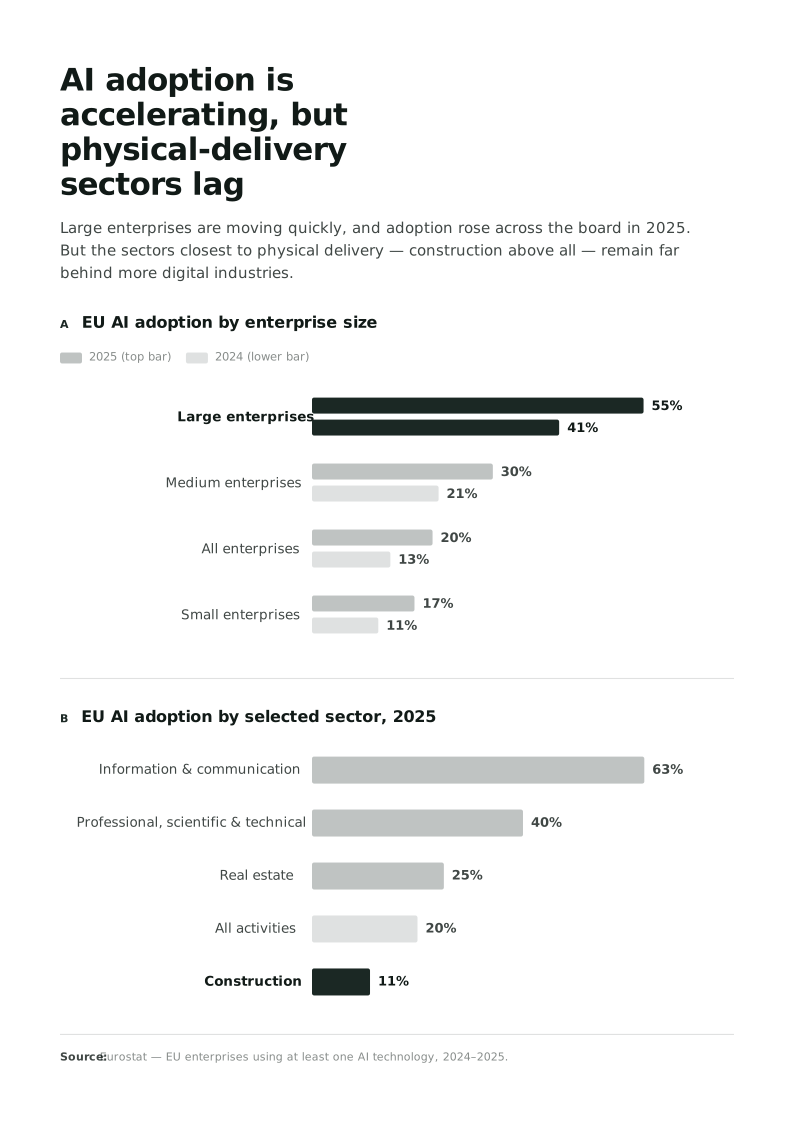
European enterprise data points in the same direction. In 2025, 20% of EU enterprises used at least one AI technology. Among large enterprises, the figure was 55%. Yet adoption varies sharply by sector: information and communication reached 63%, while construction was at 11%.
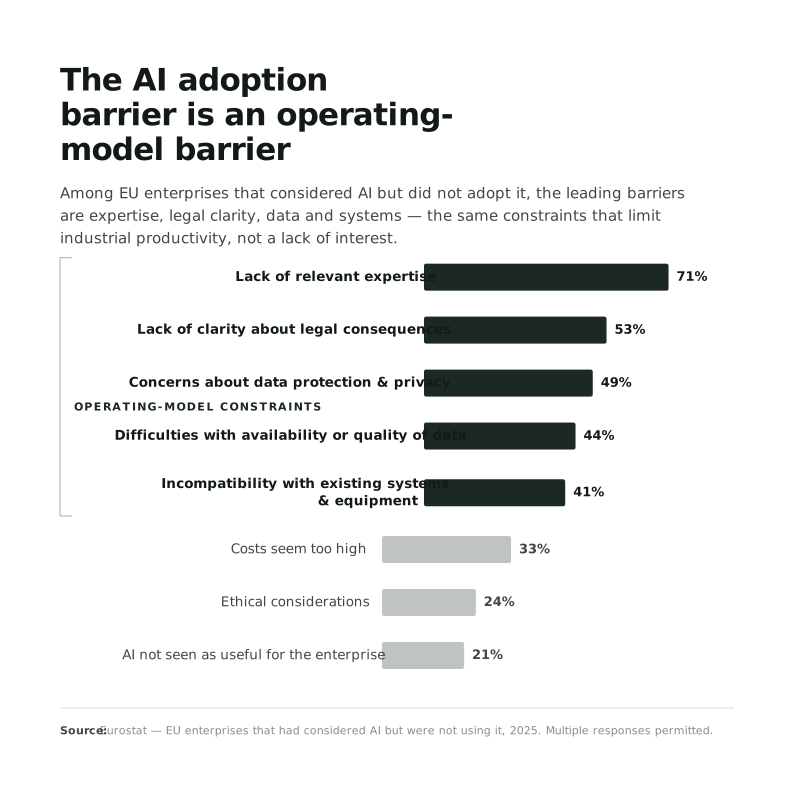
Among enterprises that had considered AI but not adopted it, the most common barrier was lack of relevant expertise, cited by 71%.
The question is not whether AI will be adopted. It is whether it will be adopted in ways that change productivity.
From AI pilots to workflow transformation
Many AI programmes start in the wrong place. They begin with a model, tool or sandbox, then search for use cases. That approach can produce useful experiments, but it often struggles to create operational value.
Critical industries need a different starting point: the workflows that matter most to the business. Not every workflow deserves equal attention. The priority should be workflows with a direct line to business objectives: faster delivery, higher asset availability, shorter cycle times, lower cost-to-serve, fewer compliance hours, less rework, better customer outcomes or improved working-capital performance.
Which critical workflows are constraining the outcomes the business needs to deliver?
The right question is not simply ‘where can we use AI?’ It is which critical workflows are constraining the outcomes the business needs to deliver. That changes the roadmap, into five moves.
- Identify the operational bottleneck. The unit of transformation is not AI adoption. It is a specific workflow tied to a measurable business objective.
- Capture the context. Connect structured enterprise data with unstructured material: documents, emails, inspection notes, historical decisions, customer records, compliance evidence and expert judgement.
- Build the application around the work. AI should not sit outside the operating model. It should help triage, recommend, draft, reconcile, escalate, evidence and automate inside the workflow.
- Keep the system explainable and reviewable. Trust is a condition of adoption. UK research found 41% of workers cited lack of trust in AI decisions, and 37% had job-security concerns. Tools operators don’t trust rarely change how work happens.
- Measure the outcome. The relevant metrics are operational: cycle time, throughput, rework, asset uptime, cost-to-serve, compliance cost, decision latency, working capital and labour productivity.
This is the logic behind Cogna’s platform. Cogna helps industrial companies build AI-native applications around high-value operational workflows: the work important enough to affect business performance, but specific enough that generic software often fails to fit. It connects with the systems companies already run, captures the operational context around the workflow, and turns it into applications deployed with the people doing the work — a faster route from productivity problem to production application.
Where the value will show up
The value of AI will not appear evenly. It will show up first in workflows that are high-volume enough to matter, complex enough to resist simple automation, and costly enough that delays have material impact.
In energy and utilities, that could mean faster grid connections, better maintenance planning, outage response, asset inspection and regulatory evidence. The economic prize is not just lower administrative cost. It is faster electrification, higher asset utilisation, shorter queues and better use of scarce engineering capacity.
In manufacturing, the opportunity sits in production exceptions, quality investigations, supplier disruption and energy optimisation. AI can help teams understand what has changed, recommend the next best action and reduce the time between signal and response. The relevant outcomes are downtime, yield, first-time-right performance, working capital and margin.
In infrastructure and construction, AI can improve document control, permitting, contractor coordination, change management and safety evidence. The prize is lower rework, faster approvals, fewer disputes and better schedule confidence.
These are not glamorous use cases. That is why they matter. Europe’s productivity challenge will not be solved only by frontier laboratories or headline-grabbing AI applications. It will be solved in the workflows where physical delivery happens every day.
The leadership shift
The next phase of industrial AI requires a shift in management attention. The question is not ‘What is our AI strategy?’
The better question is: ‘Where is our execution capacity constrained?’
That question changes the roadmap. It pushes AI away from isolated pilots and toward the work that determines productivity. It makes operations, technology and frontline adoption part of the same agenda. It also forces clearer accountability: if AI is not improving decision speed, throughput, rework, compliance effort, asset performance or labour productivity, it is not yet changing the business.
This matters because Europe’s industrial challenge is not only to invest more. It is to convert investment into output. Draghi’s report argues that the EU–US GDP gap has been driven mainly by Europe’s slower productivity growth, and that Europe largely missed the productivity gains of the internet-led digital revolution.
AI gives Europe another chance, but only if it is applied differently. A generic AI race will favour companies with the largest data sets, deepest capital pools and strongest digital talent. A workflow-first industrial AI strategy gives Europe a more plausible advantage: its critical industries have deep domain expertise, accumulated operational data, sophisticated safety and regulatory practices, and real-world complexity that cannot be abstracted away. The task is to turn those strengths into productivity.
Rebuilding Europe from the operating model up
Europe’s industrial renewal is often described in terms of what needs to be built: factories, grids, clean-tech capacity, defence supply chains, ports and infrastructure. That is right, but incomplete. Europe also needs to rebuild the operating model beneath those assets.
The continent already has many of the ingredients it needs: engineering depth, industrial heritage, regulated operating experience, complex infrastructure and decades of operational data. The problem is that too much of that advantage is fragmented. Data sits in systems. Expertise sits in people’s heads. Process sits in local workarounds. Decisions sit in approval chains. Evidence sits in documents.
AI can help connect those pieces when it is aimed at the real work of critical industries: the workflows that determine whether capacity becomes output, whether investment becomes performance, and whether complexity becomes a source of advantage or delay.
Rebuilding Europe will require new capacity. But capacity alone is not competitiveness. The next industrial advantage will belong to organisations that can convert capacity into capability, and capability into productivity. That is the role AI can play: helping critical industries turn complexity into execution, and execution into growth.
Europe’s industrial reset will be built in policy. It will be funded through investment. But it will be won, or lost, inside the operating model.