Can AI Solve the Productivity Crisis in the UK's Physical Industries?
New research on the productivity gap in the UK’s physical industries, and what leaders can do to maximize the impact of AI
Download the report
Explore the data behind the UK’s productivity challenge, the operational constraints holding companies back, and the role AI can play in improving how work gets done
Can AI Solve the Productivity Crisis in the UK's Physical Industries?
Foreword
Ben Peters, CEO and co-founder of Cogna
Despite widespread digital transformation programmes over the past decade, productivity in the UK's physical industries remains low. The pace of automation in construction, utilities, logistics and manufacturing has fallen well short of expectations - its progress scattershot due to fundamental challenges with the unpredictable, often messy workflows that underpin critical work within these industries.
Skilled workers are still spending huge amounts of their time, energy and talents on manual tasks that haven't been successfully automated. And they're reliant on IT workarounds to try and get work done more quickly, because the IT systems that have been installed simply aren't up to the job. At the heart of this issue is a fundamental failure by technology providers to understand the specific challenges that the physical industries present and create solutions that are flexible enough to adapt to the work as it's currently carried out.
AI can help, but only if it is built around the operational reality of these industries. The risk is that companies repeat the mistakes of earlier transformation programmes: buying technology first and understanding the work second.
For productivity to meaningfully improve, we have to maximise the value of our workers. We need technology that amplifies human ingenuity, rather than hindering it.
Executive summary
Billions of pounds have been spent on digital transformation programmes, but there is a significant disconnect between industry leaders' perception of how new technology has boosted productivity versus workers' experience on the shop floor.
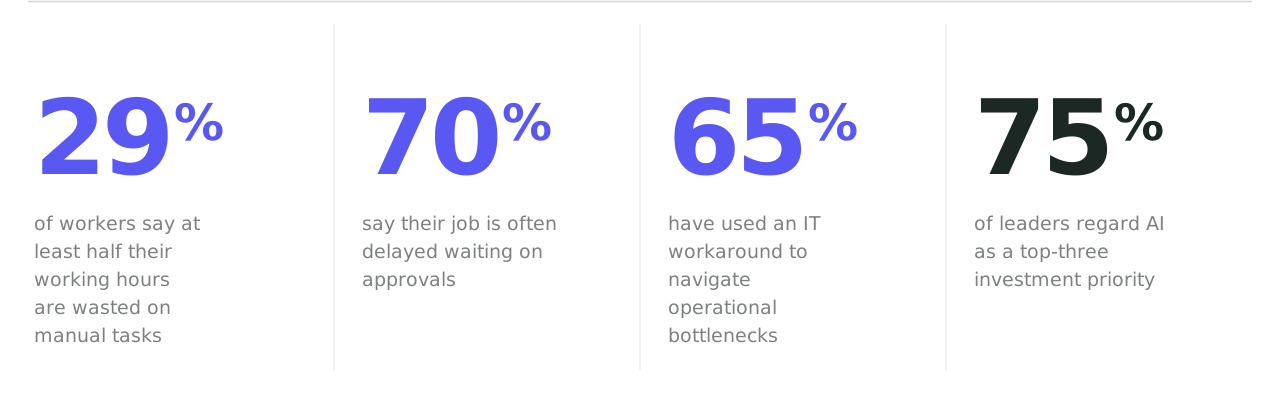
Too much of workers' time is being taken up with manual, repetitive tasks - e.g. processing job tickets, entering inventory data into spreadsheets, or reviewing delivery schedules - that could potentially be automated instead. Nearly a third of workers report that at least 50% of their working hours were wasted in this way.
Leaders still feel that a lack of skilled labour is a significant brake on productivity, but factors such as a lack of automation, mismanaged capacity, and inefficient working practices have also contributed to this problem.
For instance, 70% of workers say their job is often delayed by having to wait on approvals, while 65% of workers report using IT workarounds to navigate operational bottlenecks that digital transformation has failed to unblock.
Leaders have already seen returns from AI implementations, and 75% regard AI as a top three investment priority. However, barriers to adoption include cost and integration issues. It is also important that workers' concerns about AI in the workplace are properly addressed, and that leadership is not rushed into the wrong type of implementation.
If correctly configured and implemented, AI-based tools can fix the operational bottlenecks that still exist in the UK's physical industries, freeing workers from both the drudgery of manual tasks and a reliance on IT workarounds.
Five takeaways for leaders
- The productivity problem is also a workflow problem. UK physical industries are not only constrained by labour shortages or underinvestment. They are losing skilled time to manual tasks, approval delays and systems that do not reflect how work actually happens.
- Digital transformation has not fully reached the frontline. Leaders believe technology has improved productivity, but workers' reliance on spreadsheets, Word documents and WhatsApp suggests many official systems still do not fit operational reality.
- Workarounds should be treated as evidence, not just bad practice. When workers create their own tools to get the job done, they are revealing where processes are too slow, too rigid or poorly integrated.
- AI will only improve productivity if it is targeted at specific bottlenecks. Generic AI adoption will not fix broken workflows. The opportunity is to apply AI to the manual handoffs, approval delays and repetitive tasks that absorb skilled time.
- Worker trust will determine whether AI succeeds. If frontline workers do not understand, trust or help shape AI tools, companies risk creating another layer of technology that workers route around.
Has the digital transformation been successful?
Britain's private sector has overseen a vast investment in digital transformation initiatives over the past 20 years. In the UK's physical industries, these programmes have been predominantly designed with efficiency and productivity gains in mind, and the expectation that companies would become more productive by automating labour-intensive manual tasks, removing paper-based processes, and streamlining internal communications.
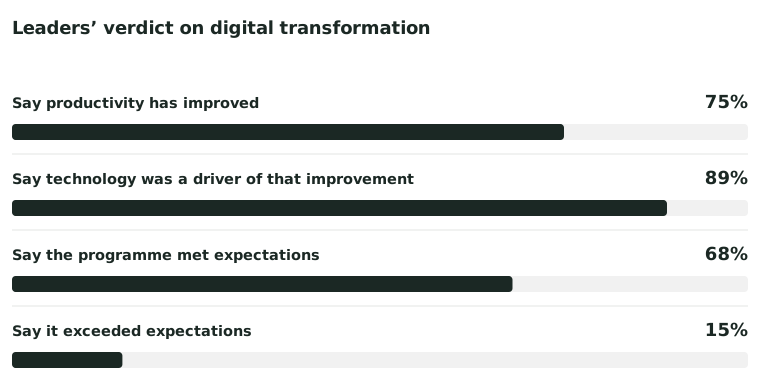
Yet workers on the frontline have a different story to tell…
How much time and effort is still being wasted?
To be as productive as possible, a company has to maximise the value of its workforce. High value employees shouldn't be spending their time on low value work.
Yet that's exactly what's occurring in the UK workplace, with skilled labour being squandered on basic, low-level activities. Two-thirds of both leaders and
workers say that at least 30% of working hours are spent this way — that’s 1.5 days of every working week.
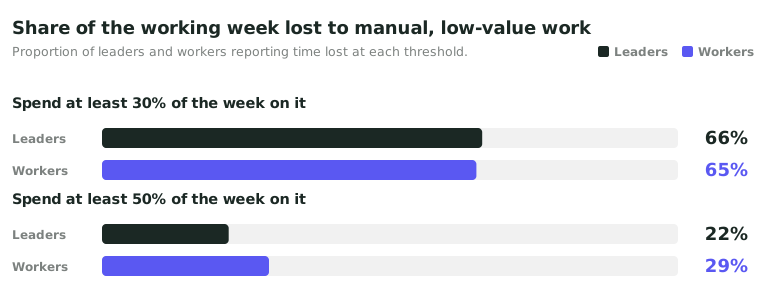
These figures represent an enormous black hole of squandered resource at the centre of UK industry. When many basic processes can now be automated, why limit the expertise of skilled employees to tasks that don't capitalise on their talents?
Wasting employee time on low value work isn't the only brake on productivity. There are also delays caused by waiting on decisions that have become stuck in a comms pipeline that doesn't work properly:
70% of workers say that they "often" have to wait for approvals before they can do their job, including 32% who wait "very often" or "always".
This suggests that UK industry is suffering from a major workflow crisis, with valuable time being lost to a decision-making process that is too slow and hindered further by a lack of communication between different parts of the company.
These operational bottlenecks are indicative of an outmoded, siloed approach to work, and IT systems that don't talk to each other. It's little wonder that productivity is impacted in such an environment, with skilled employees forced into the role of idle bystanders at work rather than active participants.
Is the skills crisis masking a capacity issue?
If workers aren't as productive as they should be due to inefficient allocation of both tasks and time, industry leaders flag another issue which they believe is hampering productivity:
52% cite "lack of skilled labour" as a major operational challenge.
The skills crisis is real in some parts of industry – but is this problem being exacerbated by the issue of mismanaged capacity in the workplace, where skilled workers' time is being wasted on low value tasks and by inefficient working practices?
If these tasks and processes were properly automated, workers' time could be freed up to spend on more valuable activities. Not only would this increase companies' productivity, it would also increase the available pool of skilled labour, mitigating apparent shortages.
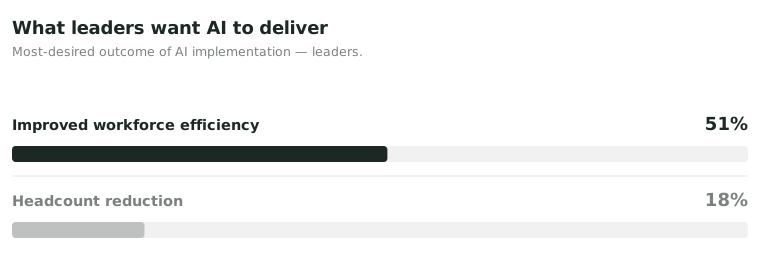
Nor is headcount reduction likely to be a long-term goal for these companies. With one in three workers in the UK over the age of 50, fears are growing about a 'silver tsunami' of older employees leaving the labour market, a problem that's particularly acute in manual and technical roles across Britain's physical industries. Leaders in these industries recognise that, if deployed effectively, AI has the potential to avert a genuine labour crisis.
Why are companies still running on 'shadow IT'?
A significant disconnect exists between leaders and workers about how technology has impacted productivity in the workplace. While leaders believe the investments they've made in the digital transformation have been successful, frustrated frontline workers believe that the 'smart revolution' isn't as smart as advertised.
Two-thirds (65%) of workers say they've been forced to use an IT workaround because the new systems they're meant to use aren't fit for purpose.
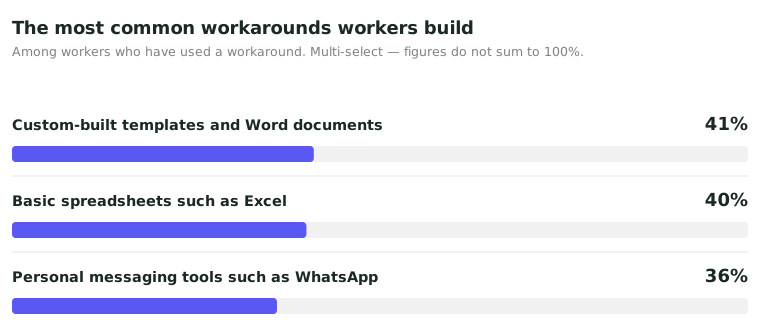
This working culture of 'shadow IT', in tandem with the mass of basic tasks that haven't yet been automated, means there's a significant productivity deficit in UK industry that technology still isn't addressing. The widespread use of shadow IT is also a threat to the integrity of company operations, leading to data inconsistency, compliance gaps, security exposure, duplicated work and poor visibility for management.
Is AI going to be a game changer for UK industry?
AI applications are already being deployed throughout UK industry, with AI near the top of nearly every company's to-do agenda:
Three-quarters (75%) of leaders regard AI as a "top three" strategic priority, although perhaps surprisingly only 21% regard it as their number one priority.
AI FOMO – fear of missing out – is a real thing, with 79% of leaders concerned that peer companies might gain a competitive productivity advantage by moving faster with their AI implementations. While this phenomenon is a positive boon for AI application makers and consultancies, there's a danger of rushing into an implementation out of fear about what competitors might be doing.
Leaders said that the main barrier to faster AI adoption was "cost" (41%), while "poor integration with existing systems" was the single biggest frustration they felt when implementing AI.
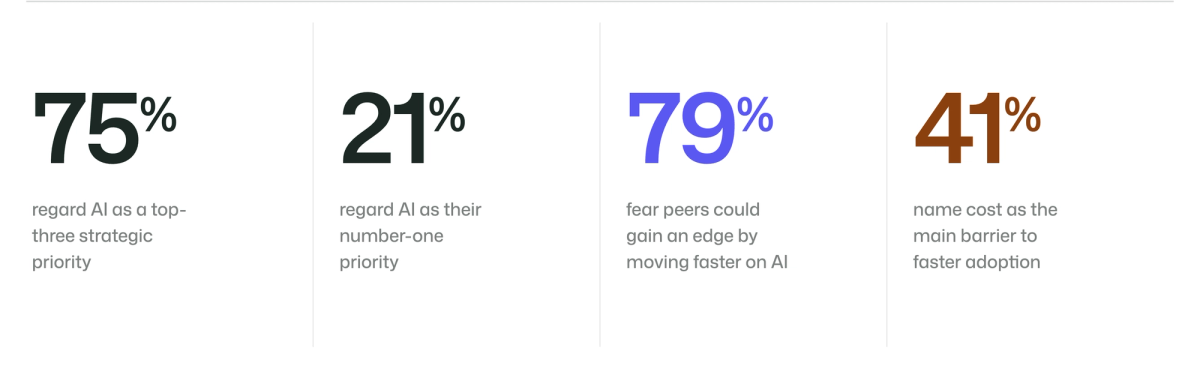
Cost and integration issues could be indicative of companies feeling rushed into AI deployments without proper evaluation or a feasibility analysis. Given the relative novelty of AI applications, it's important that consultancy fees aren't allowed to spiral out of control or generic off-the-shelf applications aren't force-fitted into legacy IT systems.
At those companies that have begun to adopt AI, operational workers have seen a positive, if relatively limited, impact on their work:
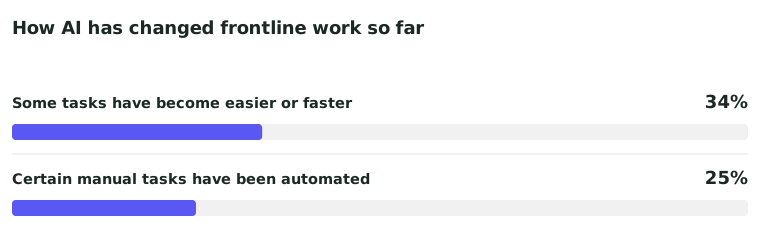
Perhaps inevitably given some of the prevailing optics around AI, some workers are experiencing a different type of fear around AI to that of their leaders:
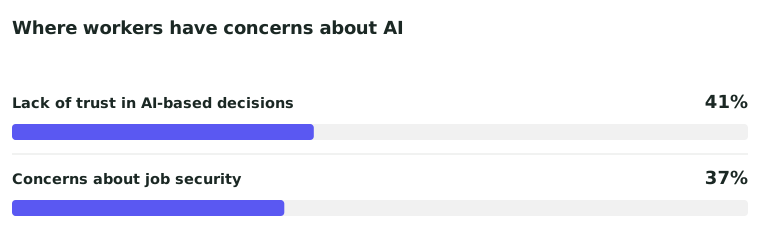
Industry leaders need to address these concerns clearly and convincingly for any kind of meaningful transition to AI to be successful. A lack of trust in AI-based decisions and concerns about job security are not soft cultural issues. They are adoption risks. If workers fear and don't trust AI-based systems, they'll route around them – exactly as they've done with existing systems.
- Workers need to understand why, how and where AI is being used
- They need confidence that AI decisions are explainable and reviewable
- They need to be involved in identifying the tasks and workflows that AI should improve
- They need assurance that the goal is to remove friction, not remove their roles
Conclusion: How leaders can unlock new levels of productivity with AI
Ultimately, productivity isn't about making workers work more hours – it's about making the hours they already work more valuable.
AI-based tools are already having an impact on the way that the UK's physical industries work, with early adopters demonstrating the benefits they can bring across a wide range of business functions. AI has the potential to reset the foundations on which the industry's systems sit, and for new levels of productivity to be built upon them.
However, lessons need to be learnt from previous stages of the digital transformation to ensure that these new tools do what they're meant to, and that workers have full buy-in regarding their roll-out. It's also vital that companies approach any AI deployment with a dispassionate and informed view, and a firm understanding of what they want to achieve.
Building a genuinely useful AI-based system requires learning the details of workflow and addressing the specific requirements of workers. Only by understanding the operational context deeply enough can tools be created that workers actually need.
About the research
The research on which this report is based was conducted among a sample of 250 leaders/senior decision makers (at the level of CEO/MD/CTO/Operations Director) and 500 frontline/operational workers (in roles including operational employees, coordinators, team leaders, field supervisors etc.). All were at companies of at least 1,000 employees, with 67% being between 1,000 and 4,999 employees, and the rest being up to 20,000 or more. The split between industries was: 32% logistics/distribution; 24% construction/infrastructure; 23% manufacturing; and 21% utilities (gas, water, electricity). The data was collected between 31 March and 8 April 2026.
The research was undertaken by Censuswide, a member of the Market Research Society (MRS) and the British Polling Council (BPC). The full data is available on request.